Ad
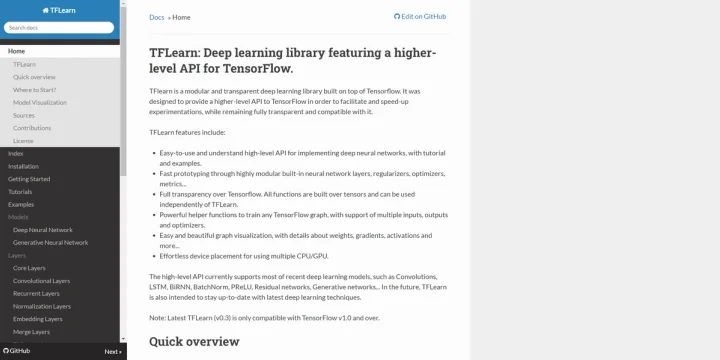
TFLearn is a deep learning library that provides a modular and user-friendly interface built on top of TensorFlow. It is designed to simplify the process of experimenting with deep neural networks while ensuring compatibility and full transparency with TensorFlow. Key Features: High-Level API: TFLearn offers an easy-to-use, high-level API for implementing deep neural networks. This makes it accessible to both beginners and experienced deep learning practitioners. The library also includes tutorials and examples to help users get started. Modular Architecture: TFLearn supports fast prototyping through a highly modular design. It includes built-in neural network layers, regularizers, optimizers, and metrics that can be easily customized and combined to create complex network architectures. Full Transparency Over TensorFlow: TFLearn operates on top of TensorFlow but ensures full transparency. All TFLearn functions are built on TensorFlow tensors, allowing users to work independently with TensorFlow if needed. Training Support: TFLearn provides powerful helper functions for training any TensorFlow graph. It supports multiple inputs, outputs, and optimizers, making it versatile for a wide range of deep learning tasks. Graph Visualization: Users can effortlessly visualize the deep learning graph created with TFLearn. The visualization includes details about weights, gradients, activations, and more, which can be invaluable for debugging and model understanding. Device Placement: TFLearn simplifies device placement, enabling users to utilize multiple CPUs or GPUs effortlessly for training deep neural networks. Supported Deep Learning Models: TFLearn's high-level API supports a variety of recent deep learning models, including but not limited to: Convolutional Neural Networks (Convolutions) Long Short-Term Memory Networks (LSTM) Bidirectional Recurrent Neural Networks (BiRNN) Batch Normalization (BatchNorm) Parametric Rectified Linear Unit (PReLU) Residual Networks (ResNets) Generative Networks (e.g., Generative Adversarial Networks, GANs) TFLearn is committed to staying up-to-date with the latest deep learning techniques, ensuring that users have access to the most recent advancements in the field. Compatibility: Please note that the latest version of TFLearn (v0.3) is compatible with TensorFlow versions 1.0 and later. Users should ensure that they have the appropriate TensorFlow version when working with TFLearn. For the most up-to-date information and resources related to TFLearn, it is recommended to visit the official website or repository for the library.