Ad
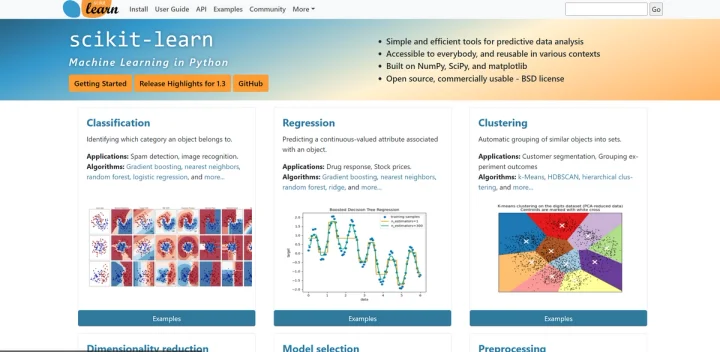
Scikit Learn offers simple and efficient tools for predictive data analysis. It is accessible to everyone and reusable in various contexts. The platform is built on NumPy, SciPy, and matplotlib, and it is open source with a commercially usable - BSD license. Key Features Classification: Identifying which category an object belongs to. Applications include spam detection and image recognition. Algorithms used include gradient boosting, nearest neighbors, random forest, logistic regression, and more. Regression: Predicting a continuous-valued attribute associated with an object. Applications include drug response and stock prices. Algorithms used include gradient boosting, nearest neighbors, random forest, ridge, and more. Clustering: Automatic grouping of similar objects into sets. Applications include customer segmentation and grouping experiment outcomes. Algorithms used include k-Means, HDBSCAN, hierarchical clustering, and more. Dimensionality reduction: Reducing the number of random variables to consider. Applications include visualization and increased efficiency. Algorithms used include PCA, feature selection, non-negative matrix factorization, and more. Model selection: Comparing, validating and choosing parameters and models. Applications include improved accuracy via parameter tuning. Algorithms used include grid search, cross validation, metrics, and more. Preprocessing: Feature extraction and normalization. Applications include transforming input data such as text for use with machine learning algorithms. Algorithms used include preprocessing, feature extraction, and more. Use Cases Scikit-learn is used for a variety of machine learning applications such as spam detection, image recognition, predicting stock prices, customer segmentation, and more. It is praised for its ease-of-use, performance, and the variety of algorithms implemented.